Tuesday, September 28, 2010

Magnetic field and the right hand rule !-@ (1-2)

A magnetic field is the distribution of a magnetic force around a magnet.
similar poles repel similar - -  (2 negative)and ++ (2 positive)
opposite poles attract (+ - )
the general direction is from the north end to the south

Magnetic Field
distribution of a magnetic force in the region of a magnet

Earth's magnetic field is produced because of a flow of hot liquid metals inside Earth

Ferromagnetic metals have atomic structure that seems to make them strongly magnetic

Domain Theory of magnets :  Large magnets are made up of small and rotating magnets, called dipoles

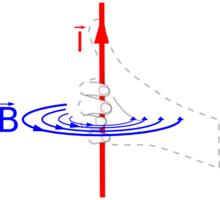
Oersted's Principle : Charge moving through a conductor produces a circular magnetic field around the conductor

First right-hand rule for conductors
Grasp conductor with the thumb of the right hand pointing in the direction of current. The finger tips is direction of the magnetic field around the conductor. (1)
 
Second right-hand rule for coils                                       (1) >>>
Grasp the coiled conductor with the right hand such that the four fingers point to the current flow. The thumb points in the direction of the magnetic field within the coil. Outside the coil, the thumb represents the north.


Tuesday, September 14, 2010

Ohm's Law

Definition and calculation
R = {V \over I}Resistance is the measure of the opposition to the current flow.

you can calculate to resistance using the formula R=V/I, resistance = voltage (volts) / current (ampere)

Factor that determine Resistance 
-thinner wires have a greater resistance then larger wires
-temperature
-marterial
-length
-cross-sectional area

Kirchhoff's laws

Kirchhoff's current law; The total amount of current that flows in to a point of a circuit the same amount comes out.
kirchhoff's voltage law: The total of all decrease in voltage will be gained back in the circuit loop.

Therefore his law states that in any circuit there is no gain or loss in charge.

Monday, September 13, 2010

chart of voltage, current, resistance (is futile) and power


Voltage


V

       
          volts

The energy between 2 points at one point in time.


Current


I

        
        Ampere


The flow of electric charge over a period of time.


Resistance


R

          
          ohm

The measure of the opposition to current flow.


Power


P


         Watts

The rate at which work is done.

Saturday, September 11, 2010

Who knew that a ping pong ball would be worth so much

Basically on Friday 10, 2010 we got in to group of fours and experimented with $600 ping pong balls or so Mr.Chung says.
Question and Answers

1. Can you make the energy ball work?
    A: Yes
    What did think makes the ball hum and flash.
    A: When placing two fingers on the metal strips the ball will hum and flash?

2. Why do you have to touch both metal strip for the ball to work?
    A: you need to connect the strips of medal to getter for the charge to pass through your fingers.

3. Will the ball light up if you connect it with any other materials
    A: Only if you use materials that can conduct electricity.

4. What material can be used?
    A: -copper
         -lead
         -skin tissues
         - Basically any conductible materials.

5. Why does this not work on certain individuals?
    A: If the person was wear a insulator like material such as rubber or leather glove.

6. Can you make the energy ball work with 5-6 individuals in your group? Will it work with the entire class?
    Yes and yes, as long as all individuals are connected.


7. What kind of a circuit can you form with one energy ball?
   A: Series circuit

8. Given two balls (combine two groups): can you create a circuit where both balls light up?
   A:Yes, by forming a parallel circuit. 

9. What do you think will happen if one person lets go of the other person’s hand and why?
    A: The energy will stop working because there will be a gap in the connector. Thus there won't be a current of charge passing through the load ( red light bulb and the speakers)

10. Does it matter who lets go?
      A: no it does not matter who let go as long as the a missing link the energy ball(s) will not work.

11. Can you create a circuit where only one ball lights (both balls must be included in the circuit)?
      A: Yes, if we use a parallel circuit and have a switch like the image to  the right
12. What is the minimum number of people required to complete this?
      A: 3 people.

Parallel or Series

A circuit made of connections in sequence is known as a series circuit where as parallel circuits are connected completely parallel to one another.

Friday, September 10, 2010

Can Superman Jump Over This?

Summary

On the second day of physics class we were given a challenge to create the highest structure among 7-8 groups, and through this activity we became more knowledgeable on some of the physics required to create tall and stable buildings.

We were given 20 minutes to create, design and build the tallest structure possible without it falling over. wihtin our group the most challenging part would be the designing. Our structure i think did pretty good, it wasn't the highest but not the shortest or the most unstable.
physic

Thin structures are usually lighter.
Support legs to balance the structure.
More weight/mass on the base.
As you go higher there's usually a gradual decrease in size.
Symmetrical structures are more stable.
Stable?

Some things that determine how stable a building can be would be its mass and weight. Most of the weight should be on the bottom of the structure. Or to make the top as light as possible. Have support at the bottom of the structure helps and have something holding the supports is a important factor as well. The build has to be symmetrical to have a good center of gravity.

Center of Gravity

The center of gravity is when an object is divided in half and both side has the some mass. For example skyscraper need to have good center of gravity to be stable. o if you were to divide a skyscraper in half both side has to be symmetrical to another.

Wednesday, September 8, 2010

Intro to Current Electricty P.544-552

Current
-Current is the flow of negatively charged elections push away of each other.

I = {Q \over t} \, ,- By using the formula (to the left) you can calculate the current.
                      I  is the current in amperes (A), Q is the charge in coulombs (C) and t stands for time.
- Alternating current : A current that is continuously moving in different directions

- Direct current : A current that only goes in a single direction, from the power supply to the load and back.

-Circuit: The path (cycle) where the electric current starts from the negative side then continuing to the positive side this is called electric current; it can also go the other way around, from positive to negative which is called conventional current. P.S Conventional current is what we're using at school.

Electrical Potential 
- Work is done by the energy supply to increase the energy potential from a present to a higher value for every charge of coulomb and as the charge pass the load the energy potential will decrease as the energy is spent.

- Electric potential difference or known as voltage (V) is the electrical potential energy in each coulomb of charge in a circuit.

-  Voltage or electric potential difference  can be calculated by using the formula V=E/Q or
                                                  energy required to increase the electric potential
   electric potential difference =    charge in coulombs
Supplying

-Electrical energy always start off as another form of energy, however though the use of conversion device we can take that original energy and turn it in to energy used to power of electronics

-Some original forms of energy can be chemical, mechanical (windmills or hydro dams), light (solar) or thermal (heat) energy.