Friday, October 22, 2010

Twin graphs?


Getting ( d=v2t+1/2at² ) Equation Number 3 from a v-t graph
 you need the 2 main equations. the "mother" and the "father"
The area of the Triangle can be calculated using -----> d=1/2(v2-v1)t 
                       Rectangle can be calculated using ---> d=v2t


Combine the two ---> d=v2t + 1/2t (v1 - v2)t <-------- (-_-)
 
a=(v2-v1) / t or at=V2-v1 <--------- (^_^)

                                             Sub (^_^) into (-_-) to form 
                                             d=1/2t(v2-v1)+v2t
                                               =1/2t(at)+v2t
                                               =v2t + 1/2at²


The area of the Triangle can be 
                                calculated using -----> d=1/2(v2-v1)t 

Large Rectangle can be calculated using ---> d=v2t

Therefore the imagery triangle minus the large Rectangle 
 
        d=V1t-1/2t(v2-v1)
         =V1t-1/2t(at)
                                                                     =v1t - 1/2at²
 

Tuesday, October 12, 2010

Matching graphs

You stay as 1m for 1 second then you walk at constant pace for 2 seconds way from origin then toward the origin for 1s then stop at 1.7-1.8m. [1]
start at 3m then you walk at constant pace for 3 second; stop at 1.5m for 1s, sprint to the origin for  second, stop at 0.5m for 2s then run away from origin[2]
Stay for 2 seconds; move at a constant pace for 2 seconds, stop for 2 seconds then walk at constant speed [3]
This in a velocity time graph. in this graph you walk backward then you speeding up , then you walk a a constant pace in the same direction. you walk forward at a constant pace then you stop. [4]
Start at 0.8m move at constant speed for 3.75s, tops for 2.5s the runs 3.25s [5]

You walk backwards for 3s then forward at a constant pace for another 3 second then you stop. [6]


[1]
If this was a a-t graph it would be a straight line on the x-axis because there was no acceleration


[2]

If this was a a-t graph it would be a straight line on the x-axis because there was no acceleration


[3] If this was a d-t graph. It would be then a line on the x-axis then a straight line at an angle going up then a line on the x-axis then a straight line at an angle going down (stops at the origin)
If this was a a-t graph it would be a straight line on the x-axis because there was no acceleration 

[4]

If this was a a-t graph there would be a positive horizontal line an a straight line on the x-axis because there was no acceleration afterward
[5] If this was a v-t graph A positive horizontal line, then a line on the x-axis then a positive horizontal line
If this was a a-t graph it would be a straight line on the x-axis because there was no acceleration

[6] If this was a d-t graph. It would be a straight line at an angle going up then a straight line at an angle going  down.
If this was a a-t graph it would be a straight line on the x-axis because there was no acceleration


Saturday, October 2, 2010

Motor; spin and burn

On Thursday 30th the whole class walked in the room in hopes that their motor will spin 3 time (1080 degrees). We all brought in supplies such as paper clip, wood, soda cans, and nail for what we couldn't bring Mr.Chung kindly brought such as the hammers and corks.

I started off by hammering the four nails in to the plank of wood with the distance of 4 cm apart while my partner Lena sanded the soda cans to perfection.
After I finished with the hammering, I try to make the axle by sticking a kabob stick through the cork. At first it seemed easy until the point where the stick reach the middle of the cork and it wouldn' move after snapping 2 kabob sticks i found out that you first use a nail fist to make a hole, finally on the  third try i successful finish make the axle and Lena finished sanding the soda can strip and making the base for the axle to rotate on.
Then my panther started warping the copper wire around the cork while I was making the base more secure.

There we are finished and only need to test it out.

Test number one (not really) : Rejected do the the wires not being parallel to the commutator pins.
Test number one  : failed commutator pins were too close to the cork.

Test number two  :Unknown

Overall I gained valuable knowledge of where my mistakes were and how to avoid them in the future.

Tuesday, September 28, 2010

Magnetic field and the right hand rule !-@ (1-2)

A magnetic field is the distribution of a magnetic force around a magnet.
similar poles repel similar - -  (2 negative)and ++ (2 positive)
opposite poles attract (+ - )
the general direction is from the north end to the south

Magnetic Field
distribution of a magnetic force in the region of a magnet

Earth's magnetic field is produced because of a flow of hot liquid metals inside Earth

Ferromagnetic metals have atomic structure that seems to make them strongly magnetic

Domain Theory of magnets :  Large magnets are made up of small and rotating magnets, called dipoles

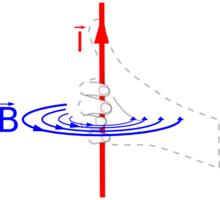
Oersted's Principle : Charge moving through a conductor produces a circular magnetic field around the conductor

First right-hand rule for conductors
Grasp conductor with the thumb of the right hand pointing in the direction of current. The finger tips is direction of the magnetic field around the conductor. (1)

 
Second right-hand rule for coils                                       (1) >>>
Grasp the coiled conductor with the right hand such that the four fingers point to the current flow. The thumb points in the direction of the magnetic field within the coil. Outside the coil, the thumb represents the north.


Tuesday, September 14, 2010

Ohm's Law

Definition and calculation
R = {V \over I}Resistance is the measure of the opposition to the current flow.

you can calculate to resistance using the formula R=V/I, resistance = voltage (volts) / current (ampere)

Factor that determine Resistance 
-thinner wires have a greater resistance then larger wires
-temperature
-marterial
-length
-cross-sectional area

Kirchhoff's laws

Kirchhoff's current law; The total amount of current that flows in to a point of a circuit the same amount comes out.
kirchhoff's voltage law: The total of all decrease in voltage will be gained back in the circuit loop.

Therefore his law states that in any circuit there is no gain or loss in charge.

Monday, September 13, 2010

chart of voltage, current, resistance (is futile) and power


Voltage


V

       
          volts

The energy between 2 points at one point in time.


Current


I

        
        Ampere


The flow of electric charge over a period of time.


Resistance


R

          
          ohm

The measure of the opposition to current flow.


Power


P


         Watts

The rate at which work is done.

Saturday, September 11, 2010

Who knew that a ping pong ball would be worth so much

Basically on Friday 10, 2010 we got in to group of fours and experimented with $600 ping pong balls or so Mr.Chung says.
Question and Answers

1. Can you make the energy ball work?
    A: Yes
    What did think makes the ball hum and flash.
    A: When placing two fingers on the metal strips the ball will hum and flash?

2. Why do you have to touch both metal strip for the ball to work?
    A: you need to connect the strips of medal to getter for the charge to pass through your fingers.

3. Will the ball light up if you connect it with any other materials
    A: Only if you use materials that can conduct electricity.

4. What material can be used?
    A: -copper
         -lead
         -skin tissues
         - Basically any conductible materials.

5. Why does this not work on certain individuals?
    A: If the person was wear a insulator like material such as rubber or leather glove.

6. Can you make the energy ball work with 5-6 individuals in your group? Will it work with the entire class?
    Yes and yes, as long as all individuals are connected.


7. What kind of a circuit can you form with one energy ball?
   A: Series circuit

8. Given two balls (combine two groups): can you create a circuit where both balls light up?
   A:Yes, by forming a parallel circuit. 

9. What do you think will happen if one person lets go of the other person’s hand and why?
    A: The energy will stop working because there will be a gap in the connector. Thus there won't be a current of charge passing through the load ( red light bulb and the speakers)

10. Does it matter who lets go?
      A: no it does not matter who let go as long as the a missing link the energy ball(s) will not work.

11. Can you create a circuit where only one ball lights (both balls must be included in the circuit)?
      A: Yes, if we use a parallel circuit and have a switch like the image to  the right
12. What is the minimum number of people required to complete this?
      A: 3 people.

Parallel or Series

A circuit made of connections in sequence is known as a series circuit where as parallel circuits are connected completely parallel to one another.